
Getting Your Medical Device Licensed in Canada? Part 1: A Practical Guide to Health Canada’s Mandatory Regulatory Enrolment Process (REP)
July 5, 2026 – As of early 2026, REP is no longer optional. Health Canada will not accept PDF forms or email submissions for Class II, III, and IV medical device licence (MDL) applications. Every manufacturer or their regulatory correspondent must now submit electronically through structured XML templates via the Common Electronic Submissions Gateway (CESG).
Miss a step, use the wrong format, or submit outside the system, and your application will be refused at the door.
This brief guide walks you through what REP is, what changed in 2026, the step-by-step submission sequence, and the most common mistakes we see companies make.
What is REP and Why Does it Matter?
The Regulatory Enrolment Process (REP) is Health Canada’s system for collecting and managing regulatory information before a medical device application can be submitted. It replaces the old PDF-based forms with a set of web-based templates that generate structured XML files, transmitted securely through the CESG.
Think of REP as your regulatory identity with Health Canada. It assigns your company a unique Company ID, ties your products to Dossier IDs, and establishes the structured foundation every submission is built on.
No REP enrollment, no submission. Your licence application will not even get to the starting line.
What is CESG?
CESG is the secure online portal through which all regulatory submissions reach Health Canada. This digital system ensures that regulatory documents and safety data for health products are transmitted, validated, and processed safely and efficiently.
What Changed in 2026 and Why It Affects You Now
This is the section your team needs to read carefully.
REP became mandatory in April 2026. Health Canada formally announced the mandatory transition in the updated Guidance on Managing Applications for Medical Device Licences, released in November 2025. Email-based submissions are no longer accepted for Class II–IV devices.
This applies to all Class II–IV medical device licence manufacturers selling in Canada, even those using a Canadian regulatory correspondent. If your regulatory correspondent is not properly configured for REP and CESG, they won’t be able to submit on your behalf.
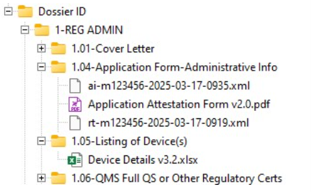
The IMDRF Table of Contents (ToC) format is now formally required for licence applications. Also in November 2025, Health Canada issued final IMDRF ToC guidance on the use of the International Medical Device Regulators Forum (IMDRF) ToC format content for all MDL submissions. Applications that don’t follow the required format will be screened out during the administrative review stage before an evaluator has the chance to examine them.
Example of IMDRF TOC folder structure for an MDL application from Health Canada’s REP guidance for medical devices.
The 6-Step Process for Filing a Medical Device Licence Application via REP
To file a medical device licence application through the REP, follow this order exactly; each step depends on completing the previous one correctly.
Step 1: Company Enrolment (CO Template)
The first step is to enrol your company. Complete the web-based CO Template with your legal name, address, and designated contacts. Submit the XML to Health Canada to receive your Company ID. This is your foundation. Your Company ID is the prerequisite for everything that follows. Without it, you cannot file a new licence, submit an amendment, or initiate any other regulatory transaction with Health Canada.
Step 2: Dossier ID Request Form
Once you have your Company ID and are ready to file a new licence application, request a DossierID via the web-based Dossier ID form. This ties your product’s entire regulatory lifecycle together under a single identifier.
Step 3: Regulatory Transaction (RT Template)
The RT template is a web-based XML form required for everymedical device licence application to Health Canada. It captures core data that anchors the submission including your Company ID, Dossier ID, and manufacturer details. Generate the RT XML file to include in your submission package.
Step 4: Application Information (AI Template)
The AI template is a web-based XML form that collects information about your application and its corresponding devices. It is required for new and amended Class II–IV device licences, including minor change amendments, manufacturer name or address changes, and private label licence applications. Download, complete, and generate the AI XML file to include in your submission package.
Step 5: Assemble Submission Dossier
Before uploading through the CESG, your full dossier must be arranged to match the IMDRF ToC structure. This includes using the prescribed folder hierarchy and file naming conventions throughout.
Step 6: CESG Submission
Send your application to Health Canada using the official electronic gateway, which is jointly administered with the FDA. Stay tuned for Part 2 in this series, where we drill down into the CESG requirements.
The Top Mistakes We See
- Starting submission preparation without confirming your identifiers.
Secure your Company ID and Dossier ID before finalizing your submission. Early drafting is fine, but these identifiers must be in place before you can complete or file any REP template. - Requesting your Dossier ID too early.
Health Canada requires the request to fall within eight weeks of your planned filing date. - Improperly structured dossiers.
Administrative screening verifies IMDRF ToC compliance upfront, and any deviation in folder organization or file naming will result in the submission being rejected without any substantive review taking place.
How PASB Can Help
We manage this entire process on behalf of our clients from initial company enrolment through final submission.
That includes preparing your CO Template and securing your Company ID, requesting Dossier IDs, building out your RT and AI XML files, structuring your dossier to the IMDRF ToC format, and submitting everything through CESG. Every file is saved, every ID is tracked, and every deadline is monitored.
Whether you’re a Canadian manufacturer new to the digital submission process or a foreign device company entering the Canadian market for the first time, we handle the regulatory complexity so your team can focus on the product.
Bringing a medical device to the Canadian market?
The rules changed in 2026. Let’s make sure your submission is ready.
Contact PASB MedTech Solutions → info@pasbtech.com